Server Customization
BigBlueButton has many configuration files that offer you opportunities to customize your installation.
General
Preserving changes to configuration files
BigBlueButton's components use various configuration files which are included with the installation packages. If you were to make a change to these configuration files, your changes would be lost when an updated version of the package is installed during upgrades. To prevent this loss of customizations, most components also accept overriding configuration files from /etc/bigbluebutton. That directory is not interfered with by BigBlueButton (except in cases when using the command bbb-conf --setip or --setsecret placing new values you specify).
For the full list of the configuration files and their overriding counterpart, see Configuration Files
Preserving customizations using apply-config.sh
Note that starting with BigBlueButton 2.6 we strongly recommend adding your custom settings to /etc/bigbluebutton instead. See the list of override files
Whenever you upgrade a server to the latest version of BigBlueButton, either using the manual upgrade steps or the bbb-install.sh script, if you have made custom changes to BigBlueButton's configuration files [that are deployed from packages], the packaging scripts may overwrite these changes.
To make it easier to apply your configuration changes, you can create a BASH script at /etc/bigbluebutton/bbb-conf/apply-config.sh that contains commands to apply your changes. The bbb-conf script, which is run as part of the last steps in a manual upgrade steps or using bbb-install.sh, will detect apply-config.sh and invoke it just before starting all of BigBlueButton's components.
In this way, you can use apply-config.sh to apply your custom configuration changes after all packages have updated but just before BigBlueButton starts.
For example, if you create /etc/bigbluebutton/bbb-conf/apply-config.sh with the following contents and make it executable with chmod +x /etc/bigbluebutton/bbb-conf/apply-config.sh
#!/bin/bash

# Pull in the helper functions for configuring BigBlueButton
source /etc/bigbluebutton/bbb-conf/apply-lib.sh

enableUFWRules
then when called by bbb-conf, the above apply-config.sh script will
- use the helper function
enableUFWRulesto restrict access to specific ports, and
Notice that apply-config.sh includes a helper script apply-lib.sh.
This helper script contains some functions to make it easy to apply common configuration changes, along with some helper variables, such as HTML5_CONFIG.
The contents of apply-config.sh are not owned by any package, so it will never be overwritten.
Common Customizations
Recording
Delete raw data from published recordings
When a meeting finishes, the BigBlueButton server archives the meeting data (referred to as the "raw" data).
Retaining the raw data lets you rebuild a recording if there was a processing issue, to enabled a new recording format, or if it was accidentally deleted by a user; however, the tradeoff is the storage of raw data will consume more disk space over time.
By default, BigBlueButton server automatically remove the raw data for a recording after 14 days of its being published. You can adjust this by editing the file /etc/cron.daily/bigbluebutton. Look for this line near the top of the file:
published_days=14
And adjust it to the desired number of days. If you would instead like to completely disable the cleanup of raw recording data, comment out the following line, near the bottom of the file:
remove_raw_of_published_recordings
Delete recordings older than N days
To delete recordings older than 14 days, create the file /etc/cron.daily/bbb-recording-cleanup with the contents
#!/bin/bash

MAXAGE=14

LOGFILE=/var/log/bigbluebutton/bbb-recording-cleanup.log

shopt -s nullglob

NOW=$(date +%s)

echo "$(date --rfc-3339=seconds) Deleting recordings older than ${MAXAGE} days" >>"${LOGFILE}"

for donefile in /var/bigbluebutton/recording/status/published/*-presentation.done ; do
        MTIME=$(stat -c %Y "${donefile}")
        # Check the age of the recording
        if [ $(( ( $NOW - $MTIME ) / 86400 )) -gt $MAXAGE ]; then
                MEETING_ID=$(basename "${donefile}")
                MEETING_ID=${MEETING_ID%-presentation.done}
                echo "${MEETING_ID}" >> "${LOGFILE}"

                bbb-record --delete "${MEETING_ID}" >>"${LOGFILE}"
        fi
done

for eventsfile in /var/bigbluebutton/recording/raw/*/events.xml ; do
        MTIME=$(stat -c %Y "${eventsfile}")
        # Check the age of the recording
        if [ $(( ( $NOW - $MTIME ) / 86400 )) -gt $MAXAGE ]; then
                MEETING_ID="${eventsfile%/events.xml}"
                MEETING_ID="${MEETING_ID##*/}"
                echo "${MEETING_ID}" >> "${LOGFILE}"

                bbb-record --delete "${MEETING_ID}" >>"${LOGFILE}"
        fi
done
Change the value for MAXAGE to specify how many days to retain the presentation format recordings on your BigBlueButton server. After you create the file, make it executable.
$ chmod +x /etc/cron.daily/bbb-recording-cleanup
Move recordings to a different partition
Most of BigBlueButton's storage occurs in the /var/bigbluebutton directory (this is where all the recordings are stored). If you want to move this directory to another partition, say to /mnt/data, do the following
$ sudo bbb-conf --stop
$ mv /var/bigbluebutton /mnt/data
$ ln -s /mnt/data/bigbluebutton /var/bigbluebutton
$ sudo bbb-conf --start
Migrate recordings from a previous version
Depending of the previous version there may be some differences in the metadata generated. In order to fix that it will be necessary to execute the corresponding scripts for updating the migrated recordings.
$ cd /usr/local/bigbluebutton/core/scripts
From version 0.9
$ sudo ./bbb-0.9-beta-recording-update
$ sudo ./bbb-0.9-recording-size
From version 1.0
$ sudo ./bbb-1.1-meeting-tag
If for some reason the scripts have to be run more than once, use the --force modifier.
$ sudo ./bbb-x.x-script --force
Enable playback of recordings on iOS
The presentation playback format encodes the video shared during the session (webcam and screen share) as .webm (VP8) files; however, iOS devices only support playback of .mp4 (h.264) video files. To enable playback of the presentation recording format on iOS devices, edit /usr/local/bigbluebutton/core/scripts/presentation.yml and uncomment the entry for mp4.
video_formats:
  - webm
  - mp4
This change will cause BigBlueButton to generate an additional .mp4 file for the video components (webcam and screen share) that was shared during the session. This change only applies to new recordings. If you want this change to apply to any existing recordings, you need use the bbb-record command to rebuild them.
This change will increase the processing time and storage size of recordings with video files as it will now generate two videos: .webm and .mp4 for the webcam and screen share videos.
Always record every meeting
By default, the BigBlueButton server will produce a recording when both of the following are true:
- the meeting has been created with
record=truein the create API call, and - a moderator has clicked the Start/Stop Record button (at least once) during the meeting.
However, you can configure a BigBlueButton server to record every meeting and disable the ability for a moderator to stop the recording. Edit /etc/bigbluebutton/bbb-web.properties and set the following properties:
# Start recording when first user joins the meeting.
# For backward compatibility with 0.81 where whole meeting
# is recorded.
autoStartRecording=true

# Allow the user to start/stop recording.
allowStartStopRecording=false
To apply the changes, restart the BigBlueButton server using the command
$ sudo bbb-conf --restart
Transfer recordings
When setting up BigBlueButton on a server, you may want to transfer recordings from an older server. If your old server has all of the original recording files in the /var/bigbluebutton/recording/raw directory, then you can transfer these files to the new server using rsync.
For example, running this rsync command new server will copy over the recording file from the old server.
$ rsync -rP root@old-bbb-server.example.com:/var/bigbluebutton/recording/raw/ /var/bigbluebutton/recording/raw/
Alternatively, you could create a tar archive of the /var/bigbluebutton/recording/raw directory, and copy it with scp, or use a shared NFS mount.
After you copy over the files (either through rsync or tar-and-copy), you will then need to fix the permissions on the new server using the following chown command.
$ chown -R bigbluebutton:bigbluebutton /var/bigbluebutton/recording/raw
After transfer of recordings, view a sampling of the recordings to ensure they playback correctly (they should).
Re-process raw recordings
If you have transferred over the raw content, you can also reprocess the recordings using the newer scripts to rebuild them with the latest playback format (including any bug fixes made in the latest version). Note: Re-processing can take a long time (around 25% to 50% of the original length of the recordings), and will use a lot of CPU on your new BigBlueButton server while you wait for the recordings to process.
If you are interested in reprocessing the older recordings, try it first with one or two of the larger recordings. If there is no perceptible difference, you don't need to reprocess the others.
And initiate the re-processing of a single recording, you can do
$ sudo bbb-record --rebuild <recording_id>
where <recording_id> is the the file name of the raw recording in /var/bigbluebutton/recording/raw, such as
$ sudo bbb-record --rebuild f4ae6fd61e2e95940e2e5a8a246569674c63cb4a-1517234271176
If your old server has all of the original recording files in the /var/bigbluebutton/recording/raw directory, then you can transfer these files to the new server, for example with rsync:
If you want to rebuild all your recordings, enter the command
Warning: If you have a large number of recordings, this will rebuild all of them, and not process any new recordings until the rebuild process finishes. Do not do this unless this is you intent. Do not do this command to troubleshoot recording errors, instead see Recording Troubleshooting.
$ sudo bbb-record --rebuildall
The BigBlueButton server will automatically go through the recordings and rebuild and publish them. You can use the bbb-record --watch command to see the progress.
Transfer published recordings from another server
If you want to do the minimum amount of work to quickly make your existing recordings on an older BigBlueButton server, transfer the contents of the /var/bigbluebutton/published and /var/bigbluebutton/unpublished directories. In addition, to preserve the backup of the original raw media, you should transfer the contents of the /var/bigbluebutton/recording/raw directory.
Here is an example set of rsync commands that would accomplish this; run these on the new server to copy the files from the old server.
$ rsync -rP root@old-bbb-server:/var/bigbluebutton/published/ /var/bigbluebutton/published/
$ rsync -rP root@old-bbb-server:/var/bigbluebutton/unpublished/ /var/bigbluebutton/unpublished/
$ rsync -rP root@old-bbb-server:/var/bigbluebutton/recording/raw/ /var/bigbluebutton/recording/raw/
Other methods of transferring these files can also be used; for example, you could create a tar archive of each of the directories, and transfer it via scp, or use a shared NFS mount.
You will then need to fix the permissions on the newly copied recordings:
$ chown -R bigbluebutton:bigbluebutton /var/bigbluebutton/published /var/bigbluebutton/unpublished /var/bigbluebutton/recording/raw
If the recordings were copied from a server with a different hostname, you will have to run the following command to fix the stored hostnames. (If you don't do this, it'll either return a 404 error, or attempt to load the recordings from the old server instead of the new server!)
Note that this command will restart the BigBlueButton server, interrupting any live sessions.
$ sudo bbb-conf --setip <ip_address_or_hostname>
For example,
$ sudo bbb-conf --setip bigbluebutton.example.com
The transferred recordings should be immediately visible via the BigBlueButton recordings API.
Change processing time
On a 2.2.x BigBlueButton server, the server will process recordings as meetings finish. You can restrict the recording processing interval to specific hours by creating the file /etc/systemd/system/bbb-record-core.timer.d/override.conf with the contents
[Timer]
OnActiveSec=
OnUnitInactiveSec=
OnCalendar=21,22,23,00,01,02,03:*:00
Persistent=false
and do systemctl daemon-reload. This file overrides the timing of when systemd runs bbb-record-core.target. In the above example, recordings will start processing between 21:00 and 03:59.
Allow all recordings to be returned
In 2.6.x a new configuration property, allowFetchAllRecordings, was added to bigbluebutton.properties. This property determines whether every recording on the server can be returned in a single response from a getRecordings call. By default this property is set to true. On a server with a large number of recordings an attempt to return every recording in a single response can cause a large amount of load on the server and therefore it is advised that this property be switched to false. When this is done any request to getRecordings that does not specify any recording or meeting IDs as well as no pagination parameters will return no recordings to prevent all recordings from being returned.
Increase the number of recording workers
Warning
If the
defaultKeepEventsormeetingKeepEventssetting in bbb-web is enabled, you must not increase the number of BigBlueButton recording workers. Doing so could result in data loss, as meeting events will not be correctly archived.For more information, see BigBlueButton issue #12503.
Run systemctl edit bbb-rap-resque-worker.service, and insert the following into the editor, replacing the number with the desired number of recordings to process concurrently.
[Service]
Environment=COUNT=3
Then restart the worker process: systemctl restart bbb-rap-resque-worker.service
If you run systemctl status bbb-rap-resque-worker.service now, you will see that it has the desired number of workers ready to process recordings in parallel:
● bbb-rap-resque-worker.service - BigBlueButton resque worker for recordings
   Loaded: loaded (/usr/lib/systemd/system/bbb-rap-resque-worker.service; disabled; vendor preset: enabled)
  Drop-In: /etc/systemd/system/bbb-rap-resque-worker.service.d
           └─override.conf
   Active: active (running) since Sat 2021-01-09 12:19:22 UTC; 6s ago
 Main PID: 23630 (sh)
    Tasks: 15 (limit: 4915)
   CGroup: /system.slice/bbb-rap-resque-worker.service
      ├─23630 /bin/sh -c /usr/bin/rake -f ../Rakefile resque:workers >> /var/log/bigbluebutton/bbb-rap-worker.log
      ├─23631 /usr/bin/ruby /usr/bin/rake -f ../Rakefile resque:workers
      ├─23650 resque-2.0.0: Waiting for rap:archive,rap:publish,rap:process,rap:sanity,rap:captions
      ├─23651 resque-2.0.0: Waiting for rap:archive,rap:publish,rap:process,rap:sanity,rap:captions
      └─23652 resque-2.0.0: Waiting for rap:archive,rap:publish,rap:process,rap:sanity,rap:captions
Install additional recording processing formats
In addition to the presentation format that is installed and enabled by default, there are several optional recording formats available for BigBlueButton:
notes: Makes the shared notes from the meeting available as a document.screenshare: Generate a single video file from the screensharing and meeting audio.podcast: Generate an audio-only recording.video: Generate a recording containing the webcams, presentation area, and screensharing combined into a single video file.
The processing scripts and playback support files for these recording formats can be installed from the packages named bbb-playback-formatname (e.g. bbb-playback-video)
There is currently an issue where the recording formats are not automatically enabled when they are installed - see #12241 for details.
In order to enable the recording formats manually, you need to edit the file /usr/local/bigbluebutton/core/scripts/bigbluebutton.yml. Look for the section named steps:. In this section, the recording processing workflow is defined, including what recording processing steps are performed, and what order they need to be performed in. To ensure that your modifications are not lost when a new version of the packages is installed, you can [create the file and] write your changes to /etc/bigbluebutton/recording/recording.yml.
To enable a new recording format, you need to add a new step named process:formatname that runs after the step named captions, and a new step named publish:formatname that runs after process:formatname. You may have to convert some of the steps to list format.
For example, here are the stock steps in BigBlueButton 3.0 with the presentation format enabled:
steps:
  archive: 'sanity'
  sanity: 'captions'
  captions: 'process:presentation'
  'process:presentation': 'publish:presentation'
If you additionally enable the video recording format, the steps will have to be changed to look like this:
cat /etc/bigbluebutton/recording/recording.yml
steps:
  archive: 'sanity'
  sanity: 'captions'
  captions:
    - 'process:presentation'
    - 'process:video'
  'process:presentation': 'publish:presentation'
  'process:video': 'publish:video'
This pattern can be repeated for additional recording formats. Note that it's very important to put the step names containing a colon (:) in quotes.
After you edit the configuration file, you must restart the recording processing queue: systemctl restart bbb-rap-resque-worker.service in order to pick up the changes.
To disable one or more enabled recording formats for a single meeting, pass meta_bbb-disable-recording-formats on the create API call with a comma-separated list of format names. For example, meta_bbb-disable-recording-formats=video,presentation (or meta_bbb-disable-recording-formats=[video,presentation]) skips the video and presentation recording formats for that meeting. The format names are case-insensitive and match the format part of the recording steps. Disabled formats are not processed or published, so they do not trigger recording-ready callbacks.
The following script will enable the video recording format of a BigBlueButton 2.6+ server.
#!/bin/bash
mkdir -p /etc/bigbluebutton/recording
cat > /etc/bigbluebutton/recording/recording.yml << REC
steps:
  archive: "sanity"
  sanity: "captions"
  captions:
    - process:presentation
    - process:video
  process:presentation: publish:presentation
  process:video: publish:video
REC
if ! dpkg -l | grep -q bbb-playback-video; then
  apt install -y bbb-playback-video
  systemctl restart bbb-rap-resque-worker.service
fi
Enable generating mp4 (H.264) video output
By default, BigBlueButton generates recording videos as .webm files using the VP9 video codec. These are supported in most desktop web browsers, but might not work on iOS mobile devices. You can additionally enable the H.264 video codec in some recording formats (Keep in mind that the following .yml files mentioned ahead only exist when the respective format package is installed):
video
Edit the file /usr/local/bigbluebutton/core/scripts/video.yml and uncomment the lines under the formats: label for the mimetype video/mp4.
The encoding options can be adjusted to speed up encoding or increase quality of video generation as desired.
presentation
Edit the file /usr/local/bigbluebutton/core/scripts/presentation.yml and uncomment the entry for mp4:
video_formats:
  - webm
  - mp4
screenshare
Edit the file /usr/local/bigbluebutton/core/scripts/screenshare.yml and uncomment the lines under the :formats: label for the mime type video/mp4:
  - :mimetype: 'video/mp4; codecs="avc1.640028, mp4a.40.2"'
    :extension: mp4
    :parameters:
      - [ '-c:v', 'libx264', '-crf', '21', '-preset', 'medium', '-profile:v', 'high', '-level', '40', '-g', '240',
          '-c:a', 'aac', '-b:a', '96K',
          '-threads', '2', '-f', 'mp4', '-movflags', 'faststart' ]
The encoding options can be adjusted to speed up encoding or increase quality of video generation as desired.
Video
Reduce bandwidth from webcams
You can use a bandwidth usage on your BigBlueButton server using a tool such as bmon (sudo apt-get install bmon). You can change the maximum bandwidth settings for each webcam options (low, medium, high, high definition) by editing /usr/share/bigbluebutton/html5-client/private/config/settings.yml and modifying the entries for
cameraProfiles:
  - id: low
    name: Low quality
    default: false
    bitrate: 100
  - id: medium
    name: Medium quality
    default: true
    bitrate: 200
  - id: high
    name: High quality
    default: false
    bitrate: 500
  - id: hd
    name: High definition
    default: false
    bitrate: 800
The settings for bitrate are in kbits/sec (i.e. 100 kbits/sec). After your modify the values, save the file, restart your BigBlueButton server sudo bbb-conf --restart to have the settings take effect. The lowest setting allowed for WebRTC is 30 Kbits/sec.
If you have sessions that like to share lots of webcams, such as ten or more, then setting the bitrate for low to 50 and medium to 100 will help reduce the overall bandwidth on the server. When many webcams are shared, the size of the webcams get so small that the reduction in bitrate will not be noticeable during the live sessions.
To ensure that your modifications are not lost when a new version of the packages is installed, you can [create the file and] write your changes to /etc/bigbluebutton/bbb-html5.yml.
Validating client settings overrides
When you override the HTML5 client settings - via /etc/bigbluebutton/bbb-html5.yml, or per meeting via the clientSettingsOverride / clientSettingsOverrideJsonUrl create parameters - keys that do not exist in the base settings.yml (typos, obsolete parameters, or values placed at the wrong level in the structure) are merged in but never read by the client, so they are silently ignored.
BigBlueButton logs a WARN in bbb-apps-akka for each such key so the problem is visible. The warning is non-blocking: the value is still applied.
For test and staging environments you can additionally enable strict validation, which turns those warnings into hard failures. It is disabled by default and controlled by a single setting, clientSettingsOverrideStrictValidation, in /etc/bigbluebutton/bbb-web.properties. Both bbb-web and bbb-apps-akka read this same property (akka reads the file directly at boot), so there is one switch and no risk of the two processes disagreeing. When set to true:
- Filesystem override (
/etc/bigbluebutton/bbb-html5.yml), enforced bybbb-apps-akkaat boot. If the override file has issues,bbb-apps-akkalogs an explicit error listing each offending key and exits (the service fails to start), so a bad config breaks the deploy instead of running silently wrong. - API override (
clientSettingsOverride/clientSettingsOverrideJsonUrl), enforced bybbb-webat create. If a/createcall carries an override with issues, the call is rejected withreturncode=FAILEDandmessageKey=clientSettingsOverrideValidationError, with the offending keys listed in the message; the meeting is not created.
Keep it false in production unless you specifically want such overrides to be rejected.
Disable webcams
You can disable webcams by setting enableVideo to false in the /etc/bigbluebutton/bbb-html5.yml file for the HTML5 client.
yq e -i '.public.kurento.enableVideo = false' /etc/bigbluebutton/bbb-html5.yml
and run bbb-conf --restart
Disable screen sharing
You can disable screen sharing by setting enableScreensharing to false in the /etc/bigbluebutton/bbb-html5.yml file for the HTML5 client.
yq e -i '.public.kurento.enableScreensharing = false' /etc/bigbluebutton/bbb-html5.yml
Reduce bandwidth for webcams
If you expect users to share many webcams, you can reduce the bandwidth for webcams.
For this you would need to make changes to public.kurento.cameraProfiles through an override.
Note: if you have made other changes in the section public.kurento.cameraProfiles in /etc/bigbluebutton/bbb-html5.yml
you would want to proceed with caution. You would likely only want to run the commands on the bottom, skipping the loading of cameraProfiles.
The following command will copy ALL of the DEFAULT camera profiles from the source /usr/share/bigbluebutton/html5-client/private/config/settings.yml to
the override location /etc/bigbluebutton/bbb-html5.yml. If you had previous related overrides, you likely do not want to run this command.
yq eval -i '.public.kurento.cameraProfiles = (load("/usr/share/bigbluebutton/html5-client/private/config/settings.yml") | .public.kurento.cameraProfiles)' /etc/bigbluebutton/bbb-html5.yml
Now that you have the list of camera profiles in /etc/bigbluebutton/bbb-html5.yml, the following yq commands will tweak the bitrate and whether the profile is default.
echo "  - Setting camera defaults"

yq eval -i '( .public.kurento.cameraProfiles[] | select(.id == "low") ).bitrate = 50' /etc/bigbluebutton/bbb-html5.yml
yq eval -i '( .public.kurento.cameraProfiles[] | select(.id == "medium") ).bitrate = 100' /etc/bigbluebutton/bbb-html5.yml
yq eval -i '( .public.kurento.cameraProfiles[] | select(.id == "high") ).bitrate = 200' /etc/bigbluebutton/bbb-html5.yml
yq eval -i '( .public.kurento.cameraProfiles[] | select(.id == "hd") ).bitrate = 300' /etc/bigbluebutton/bbb-html5.yml

yq eval -i '( .public.kurento.cameraProfiles[] | select(.id == "low") ).default = true' /etc/bigbluebutton/bbb-html5.yml
yq eval -i '( .public.kurento.cameraProfiles[] | select(.id == "medium") ).default = false' /etc/bigbluebutton/bbb-html5.yml
yq eval -i '( .public.kurento.cameraProfiles[] | select(.id == "high") ).default = false' /etc/bigbluebutton/bbb-html5.yml
yq eval -i '( .public.kurento.cameraProfiles[] | select(.id == "hd") ).default = false' /etc/bigbluebutton/bbb-html5.yml
Change screen sharing quality parameters
Screen sharing quality can be tweaked to either improve quality or reduce bandwidth usage. There are different configurations for live meetings and recordings and they need to be changed independently from each other.
For recordings, the following parameters can be changed (presentation format):
/usr/local/bigbluebutton/core/scripts/presentation.yml:deskshare_output_width(default: 1280)/usr/local/bigbluebutton/core/scripts/presentation.yml:deskshare_output_height(default: 720)/usr/local/bigbluebutton/core/scripts/presentation.yml:deskshare_output_framerate(default: 5)
As an example, suppose you want to increase the output resolution and framerate of the recorded screen share media to match a 1080p/15 FPS stream. The following changes would be necessary:
$ yq e -i '.deskshare_output_width = 1920' /usr/local/bigbluebutton/core/scripts/presentation.yml$ yq e -i '.deskshare_output_height = 1080' /usr/local/bigbluebutton/core/scripts/presentation.yml$ yq e -i '.deskshare_output_framerate = 15' /usr/local/bigbluebutton/core/scripts/presentation.yml
For live meetings, the following parameters can be changed:
/etc/bigbluebutton/bbb-html5.yml:public.kurento.screenshare.bitrate/etc/bigbluebutton/bbb-html5.yml:public.kurento.screenshare.constraints
The bitrate is specified in kbps and represents screen sharing's maximum bandwidth usage. Setting it to a higher value may improve quality but also increase bandwidth usage, while setting it to a lower value may reduce quality but will reduce average bandwidth usage.
The constraints are specified as an YAML object with the same semantics as the MediaTrackConstraints from the WebRTC specification. We recommend checking the aforementioned MDN link as well as the Media Capture and Streams API spec for an extensive list of constraints.
To set new screen sharing constraints, translate the JSON constraints object into an YAML format object and put it into public.kurento.screenshare.constraints. Restart BigBlueButton afterwards (sudo bbb-conf --restart).
As an example, suppose you want to set the maximum screen sharing resolution to 1080p, alter the maximum bitrate to 2000 kbps and set a 10 FPS target. The following would need to be added to /etc/bigbluebutton/bbb-html5.yml:
public:
  kurento:
    screenshare:
      bitrate: 2000
      constraints:
        audio: true
        video:
          width:
            max: 1920
          height:
            max: 1080
          frameRate:
            ideal: 10
            max: 10
Limit overall media streams
On any setup for BigBlueButton server there is a cap for how many media streams can be shared. A media stream is created when a user broadcasts or receives a webcam or screen share video, or when a user joins audio listening only. If your server will be using webcams, you can set limits per user, per room, and an overall limit per server in /usr/local/bigbluebutton/bbb-webrtc-sfu/config/default.yml. The default is no limit.
mediaThresholds:
  global: 0
  perRoom: 0
  perUser: 0
For example, the following settings would limit the overall number of media across all meetings to 1000 streams, the maximum number of webcam streams per meeting to 300, and no limit on the number of webcam streams per user.
mediaThresholds:
  global: 1000
  perRoom: 300
  perUser: 0
On a BigBlueButton 2.3 (or later) server, you can place the above in /etc/bigbluebutton/bbb-webrtc-sfu/production.yml, which bbb-webrtc-sfu will use to override the settings in default.yml (even after package upgrades).
If any of these thresholds are reached, then a user will receive a "Media resources not available (2002)" error when sharing webcams.
BigBlueButton will dynamically reduce the number of webcams in a meeting as the meeting grows larger. These are set in /usr/share/bigbluebutton/html5-client/private/config/settings.yml, but you can override them by placing them in /etc/bigbluebutton/bbb-html5.yml.
For example, the following /etc/bigbluebutton/bbb-html5.yml file would ensure that no single meeting will have more than 300 streams. For example, in a meeting with 30 users, the moderator will see 25 webcams and the viewers 6 webcams. This gives 25 + 29 _ 6 = 196 webcam streams. If the meeting grows to 100 users, the moderator will see 8 webcams and viewers will see 2 webcams. This gives 8 + 99 _ 2 = 206 webcam streams.
public:
    app:
        defaultSettings:
            application:
                paginationEnabled: true
    kurento:
        pagination:
            desktopPageSizes:
                moderator: 0
                viewer: 5
            mobilePageSizes:
                moderator: 2
                viewer: 2
            paginationToggleEnabled: false
        paginationThresholds:
            enabled: true
            thresholds:
            -   desktopPageSizes:
                    moderator: 25
                    viewer: 6
                users: 30
            -   desktopPageSizes:
                    moderator: 20
                    viewer: 5
                users: 40
            -   desktopPageSizes:
                    moderator: 16
                    viewer: 4
                users: 50
            -   desktopPageSizes:
                    moderator: 12
                    viewer: 4
                users: 60
            -   desktopPageSizes:
                    moderator: 8
                    viewer: 3
                users: 70
            -   desktopPageSizes:
                    moderator: 8
                    viewer: 2
                users: 80
            -   desktopPageSizes:
                    moderator: 8
                    viewer: 2
                users: 90
            -   desktopPageSizes:
                    moderator: 8
                    viewer: 2
                users: 100
HERE
Use custom images for virtual background
Starting from version 2.4 BigBlueButton offers virtual background for webcams.
To use your own background images copy them into the directory
/usr/share/bigbluebutton/html5-client/resources/images/virtual-backgrounds.
For each image copy a thumbnail of the image of 50x50 pixels size into
/usr/share/bigbluebutton/html5-client/resources/images/virtual-backgrounds/thumbnails.
To generate thumbnails you can use the following shell snippet:
#!/bin/bash
FULL="/usr/share/bigbluebutton/html5-client/resources/images/virtual-backgrounds"
THUMB="${FULL}/thumbnails"

cd "$FULL"
for pic in *.jpg; do
    convert "$pic" -resize 50x50^ -gravity Center -extent 50x50 "${THUMB}/${pic}"
done
Reference them in the configuration file /etc/bigbluebutton/bbb-html5.yml:
public:
  virtualBackgrounds:
    fileNames:
      - image1.jpg
      - image2.jpg
      - image3.jpg
Background images should not be too large as clients have to download them. You
can optimize them using the jpegoptim command which is available as an Ubuntu
package.
Audio
Mute all users on startup
If you want to have all users join muted, you can add an overwrite in /etc/bigbluebutton/bbb-web.properties and set this as a server-wide configuration.
# Mute the meeting on start
muteOnStart=true
Mute state is applied to all users joining the meeting, except telephone (dial-in) users.
If desired, enforcement can be enabled for telephone users by setting the following property in /etc/bigbluebutton/bbb-apps-akka.conf:
voiceConf {
  dialInEnforceMuteOnStart = true
}
Restart your server with sudo bbb-conf --restart to apply the changes.
Turn off "you are now muted"
When using audio through FreeSWITCH and/or mediasoup, you can remove this sound for all users by editing /opt/freeswitch/etc/freeswitch/autoload_configs/conference.conf.xml and moving the lines containing muted-sound and unmuted-sound into the commented section.
    <profile name="cdquality">
      <param name="domain" value="$${domain}"/>
      <param name="rate" value="48000"/>
      <param name="interval" value="20"/>
      <param name="energy-level" value="100"/>
      <!-- <param name="sound-prefix" value="$${sounds_dir}/en/us/callie"/> -->
      <param name="muted-sound" value="conference/conf-muted.wav"/>
      <param name="unmuted-sound" value="conference/conf-unmuted.wav"/>
      <param name="alone-sound" value="conference/conf-alone.wav"/>
<!--
      <param name="moh-sound" value="$${hold_music}"/>
      <param name="enter-sound" value="tone_stream://%(200,0,500,600,700)"/>
      <param name="exit-sound" value="tone_stream://%(500,0,300,200,100,50,25)"/>
-->
      <param name="kicked-sound" value="conference/conf-kicked.wav"/>
      <param name="locked-sound" value="conference/conf-locked.wav"/>
      <param name="is-locked-sound" value="conference/conf-is-locked.wav"/>
      <param name="is-unlocked-sound" value="conference/conf-is-unlocked.wav"/>
      <param name="pin-sound" value="conference/conf-pin.wav"/>
      <param name="bad-pin-sound" value="conference/conf-bad-pin.wav"/>
      <param name="caller-id-name" value="$${outbound_caller_name}"/>
      <param name="caller-id-number" value="$${outbound_caller_id}"/>
      <param name="comfort-noise" value="true"/>

      <!-- <param name="conference-flags" value="video-floor-only|rfc-4579|livearray-sync|auto-3d-position|minimize-video-encoding"/> -->

      <!-- <param name="video-mode" value="mux"/> -->
      <!-- <param name="video-layout-name" value="3x3"/> -->
      <!-- <param name="video-layout-name" value="group:grid"/> -->
      <!-- <param name="video-canvas-size" value="1920x1080"/> -->
      <!-- <param name="video-canvas-bgcolor" value="#333333"/> -->
      <!-- <param name="video-layout-bgcolor" value="#000000"/> -->
      <!-- <param name="video-codec-bandwidth" value="2mb"/> -->
      <!-- <param name="video-fps" value="15"/> -->

    </profile>
If you're using audio through LiveKit, you can turn off the mute sound via /etc/bigbluebutton/bbb-html5.yml:
public:
  app:
    defaultSettings:
      application:
        muteUnmuteAudioAlerts: false
Afterwards, restart bbb-apps-akka: $ sudo systemctl restart bbb-apps-akka.
Enable background music when only one person is in a session
p
FreeSWITCH enables you to have music play in the background when only one users is in the voice conference. To enable background music, edit /opt/freeswitch/conf/autoload_configs/conference.conf.xml (as root) and around line 204 you'll see the music on hold (moh-sound) commented out
<!--
      <param name="moh-sound" value="$${hold_music}"/>
      <param name="enter-sound" value="tone_stream://%(200,0,500,600,700)"/>
      <param name="exit-sound" value="tone_stream://%(500,0,300,200,100,50,25)"/>
-->
Uncomment it and save this file.
      <param name="moh-sound" value="$${hold_music}"/>
<!--
      <param name="enter-sound" value="tone_stream://%(200,0,500,600,700)"/>
      <param name="exit-sound" value="tone_stream://%(500,0,300,200,100,50,25)"/>
-->
The default BigBlueButton installation does not come with any music files. You'll need to upload a music file in WAV format to the server and change a reference in /opt/freeswitch/conf/vars.xml.
For example, to use the file /opt/freeswitch/share/freeswitch/sounds/en/us/callie/ivr/48000/ivr-to_listen_to_moh.wav as music on hold, edit /opt/freeswitch/conf/vars.xml and change the line
<X-PRE-PROCESS cmd="set" data="hold_music=local_stream://moh"/>
to
<X-PRE-PROCESS cmd="set" data="hold_music=/opt/freeswitch/share/freeswitch/sounds/en/us/callie/ivr/48000/ivr-to_listen_to_moh.wav" />
and then restart BigBlueButton
$ bbb-conf --restart
and join an audio session. You should now hear music on hold if there is only one user in the session.
Add a phone number to the conference bridge
The built-in WebRTC-based audio in BigBlueButton is very high quality audio. Still, there may be cases where you want users to be able to dial into the conference bridge using a telephone number.
Before you can configure FreeSWITCH to route the call to the right conference, you need to first obtain a phone number from a Internet Telephone Service Providers and configure FreeSWITCH accordingly to receive incoming calls via session initiation protocol (SIP) from that provider. Ensure that the context is public and that the file is called /opt/freeswitch/conf/sip_profiles/external/YOUR-PROVIDER.xml. Here is an example; of course, hostname and ALL-CAPS values need to be changed:
<include>
  <gateway name="ANY-NAME-FOR-YOUR-PROVIDER">
    <param name="proxy" value="sip.example.net"/>
    <param name="username" value="PROVIDER-ACCOUNT"/>
    <param name="password" value="PROVIDER-PASSWORD"/>
    <param name="extension" value="EXTERNALDID"/>
    <param name="register" value="true"/>
    <param name="context" value="public"/>
  </gateway>
</include>
To route the incoming call to the correct BigBlueButton audio conference, you need to create a dialplan which, for FreeSWITCH, is a set of instructions that it runs when receiving an incoming call. When a user calls the phone number, the dialplan will prompt the user to enter a five digit number associated with the conference.
To create the dialplan, use the XML below and save it to /opt/freeswitch/conf/dialplan/public/my_provider.xml. Replace EXTERNALDID with the value specified as the extension in the SIP profile (such as 6135551234, but see above).
<extension name="from_my_provider">
 <condition field="destination_number" expression="^EXTERNALDID">
   <action application="start_dtmf" />
   <action application="answer"/>
   <action application="sleep" data="1000"/>
   <action application="play_and_get_digits" data="5 9 3 30000 # conference/conf-pin.wav ivr/ivr-that_was_an_invalid_entry.wav pin \d+"/>

   <!-- Uncomment the following block if you want to mask the phone number in the list of participants. -->
   <!-- Instead of `01711233121` it will then show `xxx-xxx-3121`. -->
   <!--
   <action application="set_profile_var" data="caller_id_name=${regex(${caller_id_name}|^.*(.{4})$|xxx-xxx-%1)}"/>
   -->

   <action application="transfer" data="SEND_TO_CONFERENCE XML public"/>
 </condition>
</extension>
<extension name="check_if_conference_active">
 <condition field="${conference ${pin} list}" expression="/sofia/g" />
 <condition field="destination_number" expression="^SEND_TO_CONFERENCE$">
   <action application="set" data="bbb_authorized=true"/>
   <action application="transfer" data="${pin} XML default"/>
 </condition>
</extension>

<extension name="conf_bad_pin">
 <condition field="${pin}" expression="^\d{5}$">
   <action application="answer"/>
   <action application="sleep" data="1000"/>
   <action application="play_and_get_digits" data="5 9 3 30000 # conference/conf-bad-pin.wav ivr/ivr-that_was_an_invalid_entry.wav pin \d+"/>
   <action application="transfer" data="SEND_TO_CONFERENCE XML public"/>
 </condition>
</extension>
Change ownership of this file to freeswitch:daemon
$ chown freeswitch:daemon /opt/freeswitch/conf/dialplan/public/my_provider.xml
and then restart FreeSWITCH:
$ sudo systemctl restart freeswitch
Try calling the phone number. It should connect to FreeSWITCH and you should hear a voice prompting you to enter the five digit PIN number for the conference. Please note, that dialin will currently only work if at least one web participant has joined with their microphone.
To always show users the phone number along with the 5-digit PIN number within BigBlueButton, not only while selecting the microphone participation, edit /etc/bigbluebutton/bbb-web.properties and set the phone number provided by your Internet Telephone Service Provider
#----------------------------------------------------
# Default dial access number
defaultDialAccessNumber=613-555-1234
and set defaultWelcomeMessageFooter to
defaultWelcomeMessageFooter=<br><br>To join this meeting by phone, dial:<br> %%DIALNUM%%<br>Then enter %%CONFNUM%%# as the conference PIN number.
Save /etc/bigbluebutton/bbb-web.properties and restart BigBlueButton again. Each user that joins a session will see a message in the chat similar to.
To join this meeting by phone, dial:
   613-555-1234
and enter 12345 as the conference PIN number.
Finally, setup the firewall rules so you are only accepting incoming calls from the IP address of your SIP provider. For example, if your SIP provider forwards incoming calls from 64.2.142.33, then setup the following firewall rules on your server.
iptables -A INPUT -i eth0 -p tcp --dport 5060 -s 0.0.0.0/0 -j REJECT
iptables -A INPUT -i eth0 -p udp --dport 5060 -s 0.0.0.0/0 -j REJECT
iptables -A INPUT -i eth0 -p tcp --dport 5080 -s 0.0.0.0/0 -j REJECT
iptables -A INPUT -i eth0 -p udp --dport 5080 -s 0.0.0.0/0 -j REJECT
iptables -I INPUT  -p udp --dport 5060 -s 64.2.142.33 -j ACCEPT
With these rules, you won't get spammed by bots scanning for SIP endpoints and trying to connect.
It's also important to note that, alongside the PIN requirement, there are basic dialplan-level checks in place to prevent anonymous dial-in callers from joining BigBlueButton audio conferences.
- Those checks offer minimal protection regarding blocking anonymous SIP participants and should not be considered a comprehensive solution. For production environments requiring stronger security controls, administrators are responsible for implementing additional measures that match the sensitivity of their deployments.
- If you want to allow anonymous SIP UAs, you need to remove the
reject_anonymousextension in/opt/freeswitch/conf/dialplan/default/bbb_conference.xml, then restart FreeSWITCH.
Turn on the "comfort noise" when no one is speaking
FreeSWITCH has the ability to add a "comfort noise" that is a slight background hiss to let users know they are still in a voice conference even when no one is talking (otherwise, they may forget they are connected to the conference bridge and say something unintended for others).
If you want to enable, edit /opt/freeswitch/conf/autoload_configs/conference.conf.xml, look for the block <profile name="cdquality">, and change the value for comfort-noise. You can specify a level of noise, such as 0 (no noise), 350, 1400, etc. Try different values to get the level you desire.
<param name="comfort-noise" value="1400"/>
You need to restart BigBlueButton between each change. For more information, see comfort-noise in FreeSWITCH documentation.
$ sudo bbb-conf --restart
Presentation
Change the default presentation
When a new meeting starts, BigBlueButton displays a default presentation. The file for the default presentation is located in /var/www/bigbluebutton-default/assets/default.pdf. You can replace the contents of this file with your presentation. Whenever a meeting is created, BigBlueButton will automatically load, convert, and display this presentation for all users.
Alternatively, you can change the global default by adding an overwriting rule in /etc/bigbluebutton/bbb-web.properties specifying the URL for beans.presentationService.defaultUploadedPresentation.
# Default Uploaded presentation file
beans.presentationService.defaultUploadedPresentation=${bigbluebutton.web.serverURL}/default.pdf
You'll need to restart BigBlueButton after the change with sudo bbb-conf --restart.
If you want to specify the default presentation for a given meeting, you can also pass a URL to the presentation as part of the create meeting API call.
Increase the 200 page limit for uploads
BigBlueButton, by default, restricts uploads to 200 pages. To increase this value, add an overwrite rule in /etc/bigbluebutton/bbb-web.properties and set the maxNumPages value:
#----------------------------------------------------
# Maximum number of pages allowed for an uploaded presentation (default 200).
maxNumPages=200
After you save the changes to /etc/bigbluebutton/bbb-web.properties, restart the BigBlueButton server with
$ sudo bbb-conf --restart
Tune parallel downloads of pre-uploaded presentations
Presentations pre-uploaded through the create or insertDocument API calls are downloaded and processed in the background, on a bounded thread pool, so the API response is not delayed. By default up to 5 documents are downloaded in parallel per server; additional documents wait in a bounded queue. If the server is under sustained overload and that queue is full, further presentation tasks are rejected (and logged) instead of being queued without limit, which protects the server from running out of memory. A rejected presentation is not uploaded into the meeting, and — like a download or conversion failure — this is not reflected in the create/insertDocument API response (which has already returned); it is only visible in the server log. To change the parallelism, add an overwrite rule in /etc/bigbluebutton/bbb-web.properties and set the numPresentationDownloadThreads value (values below 1 are treated as 1):
numPresentationDownloadThreads=5
After you save the changes to /etc/bigbluebutton/bbb-web.properties, restart the BigBlueButton server with
sudo bbb-conf --restart
Increase the file size for an uploaded presentation
The default maximum file upload size for an uploaded presentation is 30 MB.
The first step is to change the size restriction in nginx. Edit /etc/bigbluebutton/nginx/web.nginx (2.4) or /usr/share/bigbluebutton/nginx/web.nginx (from 2.5 on) and modify the values for client_max_body_size.
       location ~ "^\/bigbluebutton\/presentation\/(?<prestoken>[a-zA-Z0-9_-]+)/upload$" {
          ....
          # Allow 30M uploaded presentation document.
          client_max_body_size       30m;
          ....
       }

       location = /bigbluebutton/presentation/checkPresentation {
          ....
          # Allow 30M uploaded presentation document.
          client_max_body_size       30m;
          ....
       }
Next change the restriction in bbb-web. Add an overwrite rule in /etc/bigbluebutton/bbb-web.properties and set the value maxFileSizeUpload.
# Maximum file size for an uploaded presentation (default 30MB).
maxFileSizeUpload=30000000
You will have to additionally increase the size for the HTML5 client, edit /usr/share/bigbluebutton/html5-client/private/config/settings.yml or /etc/bigbluebutton/bbb-html5.yml (recommended) and modify uploadSizeMax.
Restart BigBlueButton with sudo bbb-conf --restart. You should now be able to upload larger presentations within the new limit.
Add custom fonts for presentation conversion
Starting with BigBlueButton 2.3 we added support for using additional fonts when converting presentation files.
On the server where you want the new fonts supported you would want to download the fonts (.ttf) file. For example:
wget https://github.com/bigbluebutton/bigbluebutton/files/6391912/Street.Ruler.zip
unzip Street.Ruler.zip
Then copy the font (.ttf) to /usr/share/fonts/
sudo cp 'Street Ruler.ttf' /usr/share/fonts/
That's all! The font will be available on next presentations.
Change the limit of 300 annotations per page
In BigBlueButton 2.6 we introduced a cap for how many annotations can be added to a single whiteboard (slide). The default value is set to 300. The reason for this cap is that when a large number of annotations was added, it was often times done in the case of multi user whiteboard being enabled and a student trying to be funny. This had a negative effect on other participants in the session, specifically on limited CPU devices. In almost all cases we observed during the testing phase of BigBlueButton 2.6 this cap was sufficient for the normal run of classes. In very rare instances normal use of the whiteboard led to hitting the cap.
In order to change the value (on per-server basis) to, say, 500 annotations in your deployment, add the following to /etc/bigbluebutton/bbb-html5.yml
public:
  whiteboard:
    maxNumberOfAnnotations: 500
and restart BigBlueButton via sudo bbb-conf --restart
Configure S3-based cache for presentation assets
In BigBlueButton 3.0 we introduced a functionality to store outputs such as SVGs, PNGs, thumbnails and text generated from PDFs or document files uploaded as presentations. The processed outputs are cached in an S3-based storage system, keyed by a hash of the presentation file. When the same presentation is uploaded again, the system retrieves the cached outputs, avoiding redundant processing and improving performance.
In order to enable this feature, change the file /etc/bigbluebutton/bbb-web.properties including the following content:
presentationConversionCacheEnabled=true
presentationConversionCacheS3AccessKeyId=AAAAAAAAAAAAAAAAAAAA
presentationConversionCacheS3AccessKeySecret=aaaAAAaaaaaaaaaaaAAAAAAAAAaaaaaaaaaaaaa+aaA
presentationConversionCacheS3BucketName=my-storage-name
presentationConversionCacheS3Region=nyc3
presentationConversionCacheS3EndpointURL=https://nyc3.digitaloceanspaces.com
presentationConversionCacheS3PathStyle=false
This is an example of config for DigitalOcean Spaces S3-Compatible Object Storage.
and restart BigBlueButton via sudo bbb-conf --restart
Support for ClamAV as presentation file scanner
We have added support for ClamAV to automatically scan every presentation file for viruses before sharing it with the others in the session. To use it you would need to first install ClamAV: The simplest way would be to run it locally as a container.
docker run --name "clamav" -d \
  --volume /var/bigbluebutton:/var/bigbluebutton:ro \
  --publish 127.0.0.1:3310:3310 \
  --memory 4G \
  --cpus 1 \
  --user "clamav" \
  --entrypoint "/init-unprivileged" \
  --restart unless-stopped \
  clamav/clamav:latest
The above run command may take a minute to start. If you prefer you could run with -d flag to make it detachable.
Now when you check the running containers you should see an entry like this one:
root@test30:~# docker ps
CONTAINER ID   IMAGE                  COMMAND                CREATED             STATUS                       PORTS                                NAMES
8582c5c195aa   clamav/clamav:latest   "/init-unprivileged"   About an hour ago   Up About an hour (healthy)   127.0.0.1:3310->3310/tcp, 7357/tcp   clamav
Additionally you will have to enable scanning:
Specify scanUploadedPresentationFiles=true in /etc/bigbluebutton/bbb-web.properties and restart BigBlueButton via sudo bbb-conf --restart
When you create a new session and try uploading some presentation files, you should not see anything different if the file was fine.
However, if a threat was detected, you will see the message "Upload failed: Virus detected! Please check your file and retry." in the client and the presentation sharing will not proceed.
Additionally, in the logs for bbb-web you will see similar log lines:
Oct 09 01:07:18 test30 java[2810929]: 2024-10-09T01:07:18.285Z DEBUG o.b.w.c.PresentationController - processing file upload eicar.com.txt (presId: f7ff3fd7c0ab460f7139541c02df46f24ac90b67-1728436037947)
Oct 09 01:07:18 test30 java[2810929]: 2024-10-09T01:07:18.550Z DEBUG o.b.w.c.PresentationController - file upload success eicar.com.txt
Oct 09 01:07:23 test30 java[2810929]: 2024-10-09T01:07:23.589Z ERROR o.b.p.DocumentConversionServiceImp - Presentation upload failed for meetingId=4814d8e60f2e15576bebfe7cef34367ef5b54539-1728435987030 presId=f7ff3fd7c0ab460f7139541c02df46f24ac90b67-1728436037947
Oct 09 01:07:23 test30 java[2810929]: 2024-10-09T01:07:23.590Z ERROR o.b.p.DocumentConversionServiceImp - Presentation upload failed because a virus was detected in the uploaded file
You can test your setup with one of the files from eicar.org.
Frontends
Remove the API demos
If you have earlier installed the API demos for testing (which makes it possible for anyone to use your BigBlueButton server without authentication) and want to now remove them, enter the command:
$ sudo apt-get purge bbb-demo
Modify the default landing page
The default HTML landing page is located in
/var/www/bigbluebutton-default/assets/index.html
Change this page to create your own landing page (and keep a back-up copy of it as it will be overwritten during package updates to bbb-conf).
Use the Greenlight front-end
BigBlueButton comes with Greenlight, a front-end application written in Ruby on Rails that makes it easy for users to create meetings, invite others, start meetings, and manage recordings.
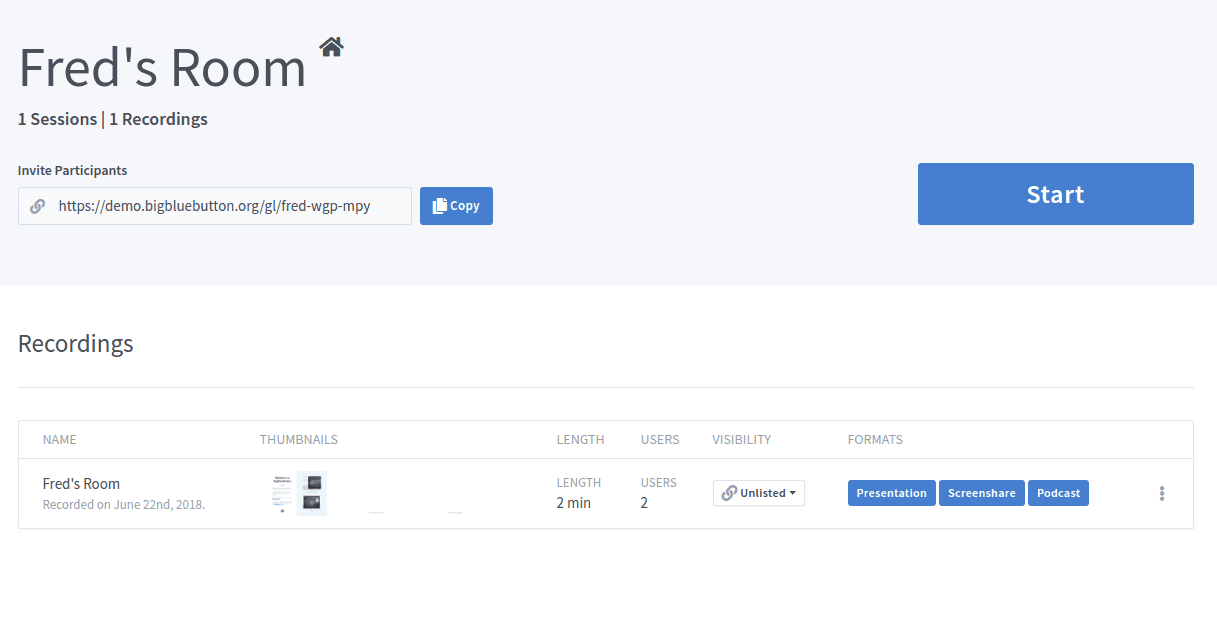
For more information see Installing Greenlight.
Networking
Setup a firewall
Configuring IP firewalling is essential for securing your installation. By default, many services are reachable across the network. This allows BigBlueButton operate in clusters and private data center networks -- but if your BigBlueButton server is publicly available on the internet, you need to run a firewall to reduce access to the minimal required ports.
If your server is behind a firewall already -- such as running within your company or on an EC2 instance behind a Amazon Security Group -- and the firewall is enforcing the above restrictions, you don't need a second firewall and can skip this section.
BigBlueButton comes with a UFW based ruleset. It it can be applied on restart and restricts access only to the following needed ports:
- TCP/IP port 22 for SSH
- TCP/IP port 80 for HTTP
- TCP/IP port 443 for HTTPS
- UDP ports 16384 to 32768 for media connections
Note: if you have configured sshd (the OpenSSH daemon) to use a different port than 22, then before running the commands below, change ufw allow OpenSSH to ufw allow <port>/tcp where <port> is the port in use by sshd. You can see the listening port for sshd using the command # netstat -antp | grep sshd. Here the command shows sshd listening to the standard port 22.
$ netstat -antp | grep sshd
tcp        0      0 0.0.0.0:22              0.0.0.0:*               LISTEN      1739/sshd
tcp6       0      0 :::22                   :::*                    LISTEN      1739/sshd
To restrict external access minimal needed ports for BigBlueButton.
BigBlueButton supplies a helper function that you can call in /etc/bigbluebutton/bbb-conf/apply-config.sh
to setup a minimal firewall (see Setup Firewall).
You can also do it manually with the following commands
$ apt-get install -y ufw
ufw allow OpenSSH
ufw allow "Nginx Full"
ufw allow 16384:32768/udp
ufw --force enable
These ufw firewall rules will be automatically re-applied on server reboot.
Besides IP-based firewalling, you can explore web application firewalls such as ModSecurity that provide additional security by checking requests to various web-based components.
Setup Firewall
To configure a firewall for your BigBlueButton server (recommended), add enableUFWRules to /etc/bigbluebutton/bbb-conf/apply-config.sh, as in
enableUFWRules
With enableUFWRule added to apply-config.sh, whenever you do bbb-conf with --restart or --setip, you'll see the following output
sudo bbb-conf --restart

Restarting BigBlueButton ..
Stopping BigBlueButton

Applying updates in /etc/bigbluebutton/bbb-conf/apply-config.sh:
  - Enable Firewall and opening 22/tcp, 80/tcp, 443/tcp and 16384:32768/udp
Rules updated
Rules updated (v6)
Rules updated
Rules updated (v6)
Rules updated
Rules updated (v6)
Rules updated
Rules updated (v6)
Firewall is active and enabled on system startup

Starting BigBlueButton
Change UDP ports
By default, BigBlueButton uses the UDP ports 16384-32768 which are used by FreeSWITCH, mediasoup and bbb-webrtc-recorder to send real-time packets (RTP).
FreeSWITCH uses the range 16384 - 24576, which is defined in /opt/freeswitch/etc/freeswitch/autoload_configs/switch.conf.xml
    <!-- RTP port range -->
    <param name="rtp-start-port" value="16384"/>
    <param name="rtp-end-port" value="24576"/>
bbb-webrtc-recorder uses the range 24577 - 32768, which is defined in /etc/bbb-webrtc-recorder/bbb-webrtc-recorder.yml (default) or /etc/bigbluebutton/bbb-webrtc-recorder.yml (override)
[...]
webrtc:
  rtcMinPort: 24577
  rtcMaxPort: 32768
[...]
mediasoup also uses 24577 - 32768 by default (defined in /usr/local/bigbluebutton/bbb-webrtc-sfu/config/default.yml). If it needs to be changed, bbb-webrtc-sfu's override configuration file (located in /etc/bigbluebutton/bbb-webrtc-sfu/production.yml) should be used. For example, setting the range to 50000 - 51999 should be of the following format (YAML syntax, /etc/bigbluebutton/bbb-webrtc-sfu/production.yml):
mediasoup:
  worker:
    rtcMinPort: 50000
    rtcMaxPort: 51999
Apply custom settings for TURN server
If you always want a specific TURN server configuration, add the following to apply-config.sh and modify aaa.bbb.ccc.ddd and secret with your values.
echo "  - Update TURN server configuration turn-stun-servers.xml"
  cat <<HERE > /usr/share/bbb-web/WEB-INF/classes/spring/turn-stun-servers.xml
<?xml version="1.0" encoding="UTF-8"?>
<beans xmlns="http://www.springframework.org/schema/beans"
        xmlns:xsi="http://www.w3.org/2001/XMLSchema-instance"
        xsi:schemaLocation="http://www.springframework.org/schema/beans
        http://www.springframework.org/schema/beans/spring-beans-2.5.xsd">
    <bean id="stun0" class="org.bigbluebutton.web.services.turn.StunServer">
        <constructor-arg index="0" value="stun:aaa.bbb.ccc.ddd"/>
    </bean>
    <bean id="turn0" class="org.bigbluebutton.web.services.turn.TurnServer">
        <constructor-arg index="0" value="secret"/>
        <constructor-arg index="1" value="turns:aaa.bbb.ccc.ddd:443?transport=tcp"/>
        <constructor-arg index="2" value="86400"/>
    </bean>
    <bean id="stunTurnService"
            class="org.bigbluebutton.web.services.turn.StunTurnService">
        <property name="stunServers">
            <set>
                <ref bean="stun0"/>
            </set>
        </property>
        <property name="turnServers">
            <set>
                <ref bean="turn0"/>
            </set>
        </property>
    </bean>
</beans>
HERE
To ensure that your modifications are not lost when a new version of the packages is installed, tweak the snippet above to cat the content to /etc/bigbluebutton/turn-stun-servers.xml instead of /usr/share/bbb-web/WEB-INF/classes/spring/turn-stun-servers.xml:
echo "  - Update TURN server configuration turn-stun-servers.xml"
  cat <<HERE > /etc/bigbluebutton/turn-stun-servers.xml
<?xml version="1.0" encoding="UTF-8"?>
<beans xmlns="http://www.springframework.org/schema/beans"
        xmlns:xsi="http://www.w3.org/2001/XMLSchema-instance"
        xsi:schemaLocation="http://www.springframework.org/schema/beans
        http://www.springframework.org/schema/beans/spring-beans-2.5.xsd">
    <bean id="stun0" class="org.bigbluebutton.web.services.turn.StunServer">
        <constructor-arg index="0" value="stun:aaa.bbb.ccc.ddd"/>
    </bean>
    <bean id="turn0" class="org.bigbluebutton.web.services.turn.TurnServer">
        <constructor-arg index="0" value="secret"/>
        <constructor-arg index="1" value="turns:aaa.bbb.ccc.ddd:443?transport=tcp"/>
        <constructor-arg index="2" value="86400"/>
    </bean>
    <bean id="stunTurnService"
            class="org.bigbluebutton.web.services.turn.StunTurnService">
        <property name="stunServers">
            <set>
                <ref bean="stun0"/>
            </set>
        </property>
        <property name="turnServers">
            <set>
                <ref bean="turn0"/>
            </set>
        </property>
    </bean>
</beans>
HERE
Legacy FreeSWITCH SIP-over-WebSocket endpoint (/ws)
Older BigBlueButton releases exposed an nginx location named /ws that proxied
SIP-over-WebSocket traffic to FreeSWITCH (audioBridge=sipjs).
It served the in-browser SIP.js audio path, deprecated since BigBlueButton 2.7
and superseded by the bbb-webrtc-sfu and LiveKit audio bridges.
This endpoint is absent on new installs and is removed on upgrade.
We recommend against reinstating /ws on any BBB install.
Migrating to any of the newer bridges is the de facto course of action, and
the sipjs bridge has been removed in the next BBB release.
HTML5 client
Change the default welcome message
The default welcome message is built from three parameters: two system-wide parameters (see below) and the welcome parameter from the BigBlueButton create API call.
You'll find the two system-wide welcome parameters defaultWelcomeMessage and defaultWelcomeMessageFooter in /usr/share/bbb-web/WEB-INF/classes/bigbluebutton.properties.
defaultWelcomeMessage=<default welcome message>
defaultWelcomeMessageFooter=<default welcome message footer>
When a front-end creates a BigBlueButton session, it may also pass a welcome parameter in the create API call.
The final welcome message shown to the user (as blue text in the Chat window) is a composite of welcome + defaultWelcomeMessage + defaultWelcomeMessageFooter.
The welcome message is fixed for the duration of a meeting. If you want to see the effect of changing the welcome parameter, you must end the current meeting or wait until the BigBlueButton server removes it from memory (which occurs about two minutes after the last person has left). You can overwrite these values in file /etc/bigbluebutton/bbb-web.properties, just remember to restart BigBlueButton with sudo bbb-conf --restart for the new values to take effect.
Modify localization for the client (override with the latest locale)
A common use case is to modify a particular string from the locales or to include newer localizations from upstream.
For example, if you would like to replace de.json with the version from a specific branch/tag of the repository, you could do the following:
cd /usr/share/bigbluebutton/html5-client/locales/
mv de.json /tmp/de.json.old
wget https://raw.githubusercontent.com/bigbluebutton/bigbluebutton/v3.0.x-release/bigbluebutton-html5/public/locales/de.json
cd /usr/share/bigbluebutton/html5-client/locales/
rm de.json
wget https://raw.githubusercontent.com/bigbluebutton/bigbluebutton/v3.0.x-release/bigbluebutton-html5/public/locales/de.json
bbb-conf --restart
Start a new meeting on the server, switch to German localization in Settings, clear the cache if needed -- frequently locales are cached.
Please use caution when replacing/editing locales. If you followed the steps above you should have a backup copy of de.json (with ".old" appended) in /tmp in case you need to revert.
Note that the json files across BigBlueButton versions are not always interchangeable. The workflow described above is only really meant for cases like
- I would like to tweak a translation for my own use
- I would like to adopt a change from upstream without having to wait for the official release in a few days
- This is part of my customization setup and I know what I need to test. I also know how to recover if needed
Change favicon
First method:
To change the favicon, overwrite the file /var/www/bigbluebutton-default/assets/favicon.ico.
You'll need to update file each time the bbb-config package updates.
Second method:
Create a custom directory under /var/www/bigbluebutton-default/ like /var/www/bigbluebutton-default/site and copy your favicon.ico into this directory. Add a new file favicon.nginx to /etc/bigbluebutton/nginx and add the following lines:
location = /favicon.ico {
    alias /var/www/bigbluebutton-default/site/favicon.ico;
After a restart of nginx, your customized favicon.ico will be delivered. This change will affect BigBlueButton and Greenlight and will persist during updates.
Change title in the HTML5 client
The configuration file for the HTML5 client is located in /usr/share/bigbluebutton/html5-client/private/config/settings.yml. It contains all the settings for the HTML5 client.
We recommend you make any adjustments to these configurations in the override file /etc/bigbluebutton/bbb-html5.yml so they are not lost when updating the system.
To change the title, edit bbb-html5.yml and change the entry for public.app.clientTitle
public:
  app:
    ...
    clientTitle: BigBlueButton
The following command can be used too.
$ yq e -i ".public.app.clientTitle = \"New Title\"" /etc/bigbluebutton/bbb-html5.yml
Apply lock settings to restrict webcams
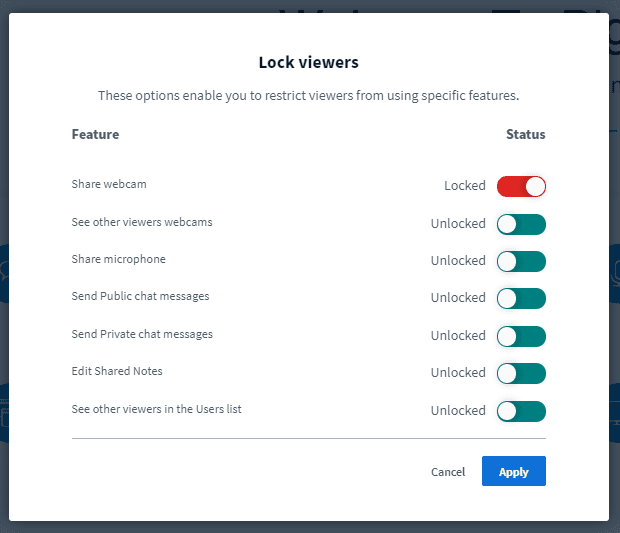
To enable lock settings for Share webcam by default (viewers are unable to share their webcam), add the following to /etc/bigbluebutton/bbb-web.properties.
# Prevent viewers from sharing webcams
lockSettingsDisableCam=true
After restart, if you open the lock settings you'll see Share webcam lock enabled.
Change the default path for HTML5 client
The default URL path for the client is /html5client, and it can be changed to match your preferences.
Edit nginx configuration file (/usr/share/bigbluebutton/nginx/bbb-html5.nginx), replacing all instances of /html5client with the new path;
Do the same in /usr/share/bbb-web/WEB-INF/classes/bigbluebutton.properties in the following lines:
defaultHTML5ClientUrl=${bigbluebutton.web.serverURL}/html5client/
You can overwrite that value in /etc/bigbluebutton/bbb-web.properties (recommended).
In configuration file for the HTML5 client, located in /usr/share/bigbluebutton/html5-client/private/config/settings.yml, change the entry for public.app.basename:
public:
  app:
    ...
    basename: '/html5client'
You can overwrite that value in /etc/bigbluebutton/bbb-html5.yml (recommended).
Finally, run the following command to reload configuration:
sudo service nginx reload && sudo bbb-conf --restart
Enable live captions
BigBlueButton has the ability to use Chrome's built-in speech-to-text API to give users the option to have their audio live captioned for other users in the session. When live captions are enabled on the server, a user can choose their language from the drop-down list when joining audio.
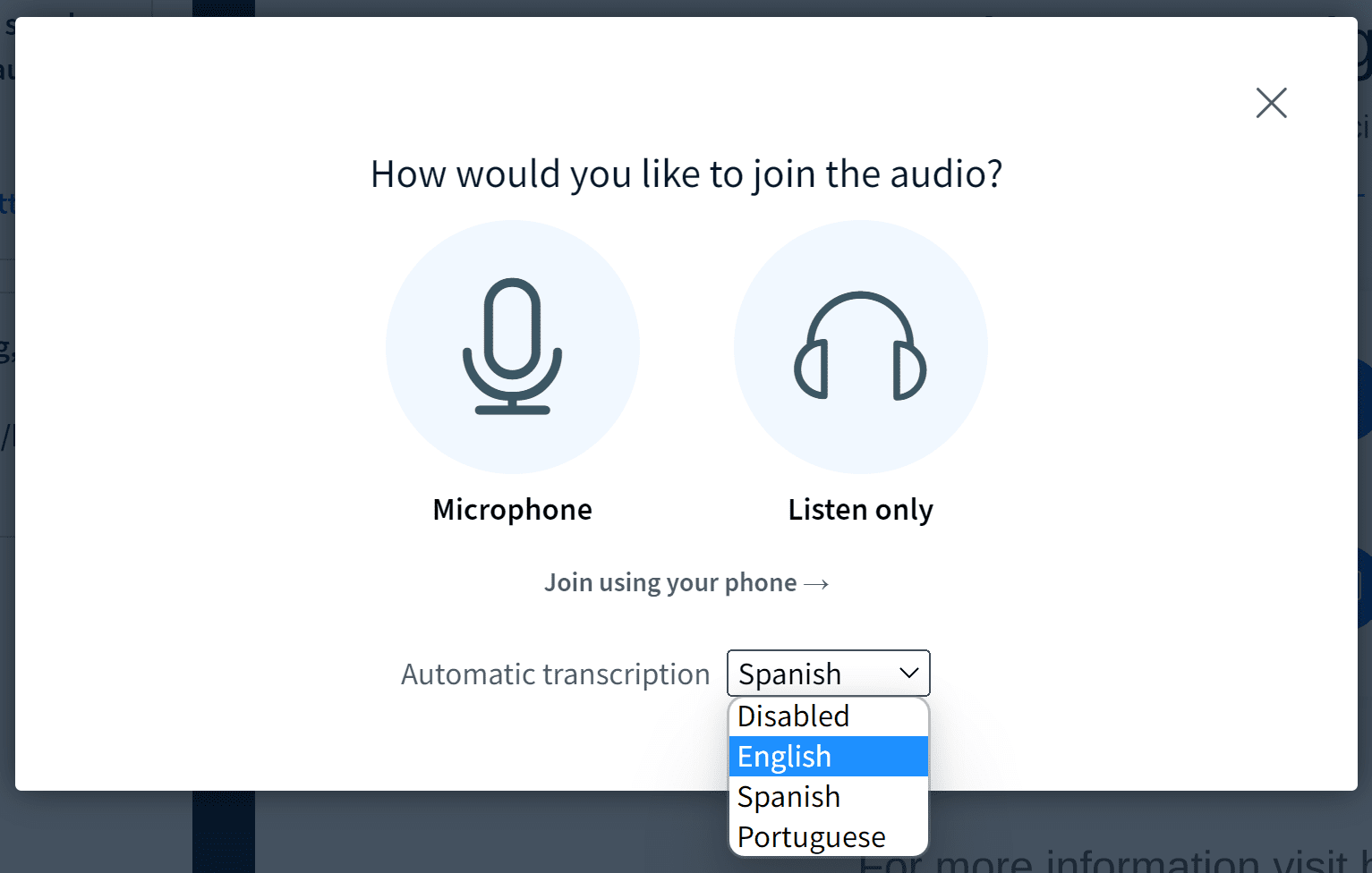
These captions will automatically appear in the recordings. To enable live captions, edit /etc/bigbluebutton/bbb-html5.yml and add the following
public:
  app:
    # You may have other setting items here
    audioCaptions:
      enabled: true
Restart BigBlueButton with sudo bbb-conf --restart and you should now see the options for live captions when joining audio.
Configuration of gladia.io
To use gladia.io for automatic speech-to-text transcriptions, you first need to obtain an API key from gladia.io. You can sign up for free credentials to test the integration. Note: The "Free Trial" plan only allows up to 1 concurrent session
Next, you must be using BigBlueButton 2.7.4+ (pass -v focal-270) or BigBlueButton 3.0.0-alpha.7+ (pass -v jammy-300) or later on a BigBlueButton server with a public IP and hostname.
Once you have BigBlueButton installed, run sudo apt install bbb-transcription-controller to install BigBlueButton's transcription service which supports gladia.io.
Next, run sudo bbb-conf --setip <hostname> where <hostname> is the external hostname of the server (same as was passed to bbb-install.sh). This will update the bbb-transcription-controller configuration.
Next, to enable gladia.io, run the following two commands
sudo yq e -i '.public.app.audioCaptions.enabled = true' /etc/bigbluebutton/bbb-html5.yml
sudo yq e -i '.public.app.audioCaptions.provider = "gladia"' /etc/bigbluebutton/bbb-html5.yml
Next, set the gladia.io API key using the command below, replacing <gladia_api_key> with a glada.io API key obtained above.
sudo yq e -i '.gladia.startMessage = "{\"x_gladia_key\": \"<gladia-api-key>\", \"sample_rate\": 0, \"bit_depth\": 16, \"model_type\": \"fast\", \"endpointing\": 10 }"' /usr/local/bigbluebutton/bbb-transcription-controller/config/default.yml
If you are running BigBlueButton version 3.0 or higher, use release version >0.3.x of the bbb-transcription-controller repository, install the Live Transcription plugin https://github.com/bigbluebutton/bbb-plugin-live-transcription and use the following startMessage:
sudo yq e -i '.gladia.startMessage = "{\"sample_rate\": 16000, \"bit_depth\": 16, \"endpointing\": 0.01 }"' /usr/local/bigbluebutton/bbb-transcription-controller/config/default.yml
Restart the BigBlueButton server with bbb-conf --restart. You will now be able to select a speech-to-text option when joining audio (including auto translate). When one or more users have selected the option, a CC button will appear at the bottom and a Transcript panel will also be available.
If you are using LiveKit as audio gateway, use bbb-livekit-stt instead of bbb-transcription-controller as gladia proxy.
Configure guest policy
The policy for guest management on the server is is set in the properties file for bbb-web, which is located at /usr/share/bbb-web/WEB-INF/classes/bigbluebutton.properties.
You can overwrite the default guest policy in /etc/bigbluebutton/bbb-web.properties. Just add the value you prefer, save the file and restart BigBlueButton.
# Default Guest Policy
# Valid values are ALWAYS_ACCEPT, ALWAYS_DENY, ASK_MODERATOR
#
defaultGuestPolicy=ALWAYS_ACCEPT
Configure guest lobby queue position
When the guest policy makes users wait for moderator approval, the HTML5 client shows each guest their position in the waiting queue by default. To hide this position, set public.app.showGuestLobbyWaitingQueuePosition to false in /etc/bigbluebutton/bbb-html5.yml.
public:
  app:
    showGuestLobbyWaitingQueuePosition: false
Restart BigBlueButton with sudo bbb-conf --restart for the change to take effect.
Show a custom logo on the client
Ensure that the parameter displayBrandingArea is set to true in bbb-html5's configuration, restart BigBlueButton server with sudo bbb-conf --restart and pass logo=<image-url> in Custom parameters when creating the meeting.
Changing the default logo
To update the default logo, navigate to the images folder located at /var/www/bigbluebutton-default/assets/images/, and replace the logo.png file with your new logo.
Other meeting configs available
These configs can be set in /etc/bigbluebutton/bbb-web.properties. The table is synced with bigbluebutton.properties; items marked overwritable can be replaced per meeting through the matching /create parameter.
| Parameter | Description | Options | Default value |
|---|---|---|---|
defaultMeetingLayout | Default meeting layout | UNIFIED_LAYOUT, CUSTOM_LAYOUT, SMART_LAYOUT, PRESENTATION_FOCUS, VIDEO_FOCUS, PARTICIPANTS_AND_CHAT_ONLY, CAMERAS_ONLY, PRESENTATION_ONLY, MEDIA_ONLY | CUSTOM_LAYOUT overwritable (via meetingLayout) |
defaultMaxUsers | Maximum number of users a meeting can have | Integer (0=disable) | 0 overwritable (via maxParticipants) |
maxUserConcurrentAccesses | Maximum number of sessions a single user (extId) can open simultaneously in the same meeting; oldest session is ended when exceeded | Integer (0=disable) | 3 |
defaultMeetingDuration | Default duration of the meeting in minutes | Integer (0=disable) | 0 overwritable (via duration) |
defaultGuestPolicy | Default guest policy applied to meetings | ALWAYS_ACCEPT, ALWAYS_DENY, ASK_MODERATOR | ALWAYS_ACCEPT overwritable (via guestPolicy) |
authenticatedGuest | Enable authenticated guest mode | true/false | true |
defaultAllowPromoteGuestToModerator | Allows moderators to promote guests to moderators when authenticatedGuest is enabled | true/false | false overwritable (via allowPromoteGuestToModerator) |
clientLogoutTimerInMinutes | Number of minutes to logout client if user isn't responsive | Integer (0=disable) | 0 |
meetingExpireIfNoUserJoinedInMinutes | End meeting if no user joined within a period of time after meeting created | Integer | 5 overwritable |
meetingExpireWhenLastUserLeftInMinutes | Number of minutes to end meeting when the last user left | Integer (0=disable) | 1 overwritable |
endWhenNoModerator | End meeting when there are no moderators after a certain period of time | true/false | false overwritable |
endWhenNoModeratorDelayInMinutes | Number of minutes to wait for moderator rejoin before end meeting | Integer | 1 overwritable |
userInactivityInspectTimerInMinutes | User inactivity audit timer interval | Integer (0=disable) | 0 |
userInactivityThresholdInMinutes | Number of minutes to consider a user inactive | Integer | 30 |
userActivitySignResponseDelayInMinutes | Number of minutes for user to respond to inactivity warning before being logged out | Integer | 5 |
usersTimeout | Timeout (millis) to remove a joined user after they left without a rejoin | Integer | 60000 (60s) |
waitingGuestUsersTimeout | Timeout (millis) to remove guest users that stopped fetching for their status | Integer | 30000 (30s) |
enteredUsersTimeout | Timeout (millis) to remove users that called the enter API but did not join | Integer | 45000 (45s) |
defaultHttpSessionTimeout | Timeout (seconds) to invalidate inactive HTTP sessions | Integer | 14400 (4h) |
sessionsCleanupDelayInMinutes | Minutes to wait before removing user sessions after a meeting has ended; during this delay the "Meeting has ended" screen is still reachable | Integer (0=keep indefinitely) | 60 |
webcamsOnlyForModerator | Allow webcams streaming reception only to and from moderators | true/false | false overwritable |
meetingCameraCap | Per meeting camera share limit | Integer (0=disable) | 0 overwritable |
userCameraCap | Per user camera share limit | Integer (0=disable) | 3 overwritable |
maxPinnedCameras | Maximum number of cameras pinned simultaneously | Integer (0=disable) | 3 |
muteOnStart | Microphone is muted by default when users start sharing | true/false | true overwritable |
allowModsToUnmuteUsers | Gives moderators permission to unmute other users | true/false | false overwritable |
allowModsToEjectCameras | Gives moderators permission to close other users' webcams | true/false | false overwritable |
cameraBridge | Media bridge used for camera streams | bbb-webrtc-sfu, livekit | bbb-webrtc-sfu |
screenShareBridge | Media bridge used for screen share streams | bbb-webrtc-sfu, livekit | bbb-webrtc-sfu |
audioBridge | Media bridge used for audio streams | bbb-webrtc-sfu, livekit, freeswitch | bbb-webrtc-sfu |
disableRecordingDefault | When true, do not record even if the /create call sets record=true | true/false | false |
autoStartRecording | Start recording when the first user joins the meeting | true/false | false overwritable |
allowStartStopRecording | Allow users to start/stop recording during the session | true/false | true overwritable |
defaultKeepEvents | Save meeting events even if the meeting is not recorded | true/false | false overwritable (via meetingKeepEvents) |
allowFetchAllRecordings | When true, getRecordings with no meetingID returns every recording on the server (potentially large response) | true/false | true |
recordFullDurationMedia | Whether media (audio, cameras, screen sharing) is captured on its full duration when record=true, ignoring the meeting's current paused/running recording state | true/false | false overwritable |
notifyRecordingIsOn | Notify users that recording is on | true/false | false overwritable |
lockSettingsDisableCam | Default lock setting: disable webcams | true/false | false overwritable |
lockSettingsDisableMic | Default lock setting: disable microphones | true/false | false overwritable |
lockSettingsDisablePrivateChat | Default lock setting: disable private chat | true/false | false overwritable |
lockSettingsDisablePublicChat | Default lock setting: disable public chat | true/false | false overwritable |
lockSettingsDisableNotes | Default lock setting: disable shared notes | true/false | false overwritable |
lockSettingsHideUserList | Default lock setting: hide the user list from non-moderators (since 3.0.38 also other viewers' talking indicator, voice state and reactions) | true/false | false overwritable |
lockSettingsLockOnJoin | Default lock setting: apply lock settings to all users on join | true/false | true overwritable |
lockSettingsLockOnJoinConfigurable | Allow the lock-on-join flag to be configured per meeting | true/false | false overwritable |
lockSettingsHideViewersCursor | Default lock setting: hide viewers' cursors from each other | true/false | false overwritable |
lockSettingsHideViewersAnnotation | Default lock setting: hide viewers' annotations from each other | true/false | false overwritable |
breakoutRoomsRecord | Enable recordings in breakout rooms | true/false | false overwritable |
breakoutRoomsPrivateChatEnabled | Enable private chat in breakout rooms | true/false | true overwritable |
breakoutRoomsMultiUserWhiteboardDefaultOn | Enable multi-user whiteboard by default in breakout rooms | true/false | true |
learningDashboardCleanupDelayInMinutes | Minutes the Learning Dashboard remains available after the meeting ends | Integer (0=keep permanently) | 2 overwritable |
disabledFeatures | Comma-separated list of features to disable (see /create docs for the full list of feature names) | csv | (empty) overwritable |
sharedNotesEditor | Type of shared notes editor to use | etherpad, blockNote | etherpad overwritable |
maxSharedNotesInitialContentUrlPayloadSize | Maximum size (in KiB) of the response fetched when seeding shared-notes initial content from sharedNotesInitialContentJsonUrl / sharedNotesInitialContentMarkdownUrl | Integer (KiB) | 1024 |
allowOverrideClientSettingsOnCreateCall | Allow clientSettingsOverride / clientSettingsOverrideJsonUrl to be passed on /create | true/false | false |
clientSettingsOverrideStrictValidation | When true, reject the /create call (bbb-web) and refuse bbb-apps-akka boot if a client settings override has unknown or malformed keys. Intended for test/staging (see Validating client settings overrides) | true/false | false |
clientSettingsFilePath | Path to the settings.yml catalog used as the schema for the strict client-settings override validation above | path | /usr/share/bigbluebutton/html5-client/private/config/settings.yml |
pluginManifests | List of plugin manifests as a JSON array, e.g. [{"url": "https://example.com/manifest.json"}] | JSON array | (empty) overwritable |
pluginManifestCacheEnabled | Cache plugin manifests on disk to speed up /create calls | true/false | false |
pluginManifestCacheDirectory | Base directory for cached plugin manifest files. The directory is wiped every time bbb-web starts; entries idle for over a week are also evicted automatically by the periodic refresh task | path | /var/bigbluebutton/plugin-manifests-cache/ |
pluginManifestCacheRefreshIntervalMinutes | How often (in minutes) the plugin manifest cache refresh task runs | Integer | 60 |
serviceEnabled | Whether the BigBlueButton API is enabled | true/false | true |
allowRequestsWithoutSession | Allow requests without JSESSIONID to be handled (reduces security; only enable for trusted integrations like iframes) | true/false | false overwritable |
supportedChecksumAlgorithms | Hash algorithms accepted when validating API checksums (comma-separated) | sha1, sha256, sha384, sha512 | sha1,sha256,sha384,sha512 |
pageTokenSecret | Secret used to generate per-page presentation access tokens (HMAC-SHA256). Override for additional security separation between presentation tokens and the rest of bbb-web | String | (defaults to ${securitySalt}) |
beans.presentationService.pageTokenSecret | Grails bean wiring that injects pageTokenSecret into the presentation service. Override only if the presentation service should use a different secret than pageTokenSecret | String | (defaults to ${pageTokenSecret}) |
allowRevealOfBBBVersion | Allow the getMeetings endpoint to reveal the current BigBlueButton version | true/false | false |
overwritable: The default is replaced when the matching parameter is present on an API/createrequest. Where the create-side name differs from the property name, it is shown in parentheses (e.g.,defaultMeetingLayout→meetingLayout).
/create parameters without a bigbluebutton.properties counterpart
Some /create parameters set per-meeting state but have no default in bigbluebutton.properties. Examples include name, meetingID, parentMeetingID/sequence/freeJoin/isBreakout (breakout-only), bannerText/bannerColor, moderatorOnlyMessage, notifyRecordingAppend, meta_* metadata, logo, multiUserWhiteboardEnabled, presentation-upload parameters (preUploadedPresentation*, presentationUploadExternalUrl, presentationUploadExternalDescription), sharedNotesInitialContentJsonUrl, disabledFeaturesExclude, clientSettingsOverride / clientSettingsOverrideJsonUrl, and pluginManifestsFetchUrl. See Create API parameters for the complete list and descriptions.
Passing user metadata to the client on join
The HTML5 client supports a list of parameters that can be added to the join API call which modify the look and default behaviour of the client. This list is accurate as of BigBlueButton version 2.2.17 (build 937). These parameters override the global defaults set in settings.yml. As the parameters are passed on call to join, it allows for some powerful customization that can vary depending on which user is joining the session.
Useful tools for development:
- A tool like (https://meyerweb.com/eric/tools/dencoder/) is useful in the encoding-decoding process for the fields expecting encoded value passed (see below).
- The API mate allows you to directly experiment with these user metadata. To use the API mate, run the following command on your BigBlueButton machine:
sudo bbb-conf --secret. This creates a link for you with your secret as a parameter so you can get started experimenting right away.
Application parameters
| Parameter | Description | Default value |
|---|---|---|
userdata-bbb_auto_join_audio= | If set to true, the client will start the process of joining the audio bridge automatically upon loading the client | false |
userdata-bbb_client_title= | Specifies a string to set as the HTML5 client title | BigBlueButton |
userdata-bbb_force_listen_only= | If set to true, attendees will be not be able to join with a microphone as an option (does not apply to moderators) | false |
userdata-bbb_listen_only_mode= | If set to false, the user will not be able to join the audio part of the meeting without a microphone (disables listen-only mode) | true |
userdata-bbb_skip_check_audio= | If set to true, the user will not see the "echo test" prompt when sharing audio | false |
userdata-bbb_skip_check_audio_on_first_join= | (Introduced in BigBlueButton 2.3) If set to true, the user will not see the "echo test" when sharing audio for the first time in the session. If the user stops sharing, next time they try to share audio the echo test window will be displayed, allowing for configuration changes to be made prior to sharing audio again | false |
userdata-bbb_skip_echotest_if_previous_device= | (Introduced in BigBlueButton 3.0) If set to true, the user will not see the "echo test" if session has valid input/output devices stored previously | false |
userdata-bbb_override_default_locale= | (Introduced in BigBlueButton 2.3) If set to de, the user's browser preference will be ignored - the client will be shown in 'de' (i.e. German) regardless of the otherwise preferred locale 'en' (or other) | null |
userdata-bbb_direct_leave_button | (Introduced in BigBlueButton 2.7) If set to true it will make a button to leave the meeting appear to the left of the Options menu. | false |
userdata-bbb_parent_room_moderator= | (Introduced in BigBlueButton 3.0) Only used in breakouts: if set to true, user will have permission to kick other users inside the breakout | false |
userdata-bbb_record_permission= | (Introduced in BigBlueButton 3.0) If set to true, the user will be able to control the recording start/stop. If set to false, the user will not be allowed to control the recording start/stop even if their role is moderator. Otherwise only moderators will have the control (default). | null |
userdata-bbb_record_permission_tooltip= | (Introduced in BigBlueButton 3.0) If set, the tooltip of the recording indicator shown when the user don't have permission to record will be replaced by its content. | null |
userdata-bbb_show_session_details_on_join= | (Introduced in BigBlueButton 3.0) If set to false , the session details window will not be displayed when a user joins the session. | null |
userdata-bbb_show_animations_default= | If set to false , animations (emoji raining, whiteboard toolbars fading out, etc) will not be shown to the user. | true |
Branding parameters
| Parameter | Description | Default value |
|---|---|---|
userdata-bbb_display_branding_area= | If set to true, the client will display the branding area in the upper left hand corner | true |
Shortcut parameters
| Parameter | Description | Default value |
|---|---|---|
userdata-bbb_shortcuts= | The value passed has to be URL encoded. For example if you would like to disable shortcuts, pass %5B%5D which is the encoded version of the empty array [] | See settings.yml |
Media parameters
| Parameter | Description | Default value |
|---|---|---|
userdata-bbb_auto_share_webcam= | If set to true, the client will start the process of sharing webcam (if any) automatically upon loading the client | false |
userdata-bbb_preferred_camera_profile= | Specifies a preferred camera profile to use out of those defined in the settings.yml | none |
userdata-bbb_enable_video= | If set to false, the client will display the webcam sharing button (in effect disabling/enabling webcams) | true |
userdata-bbb_record_video= | If set to false, the user won't have her/his video stream recorded | true |
userdata-bbb_skip_video_preview= | If set to true, the user will not see a preview of their webcam before sharing it | false |
userdata-bbb_skip_video_preview_on_first_join= | (Introduced in BigBlueButton 2.3) If set to true, the user will not see a preview of their webcam before sharing it when sharing for the first time in the session. If the user stops sharing, next time they try to share webcam the video preview will be displayed, allowing for configuration changes to be made prior to sharing | false |
userdata-bbb_skip_video_preview_if_previous_device= | (Introduced in BigBlueButton 3.0) If set to true, the user will not see a preview of their webcam before sharing it if session has a valid input device stored previously | false |
userdata-bbb_mirror_own_webcam= | If set to true, the client will see a mirrored version of their webcam. Doesn't affect the incoming video stream for other users. | false |
userdata-bbb_fullaudio_bridge= | Specifies the audio bridge to be used in the client. Supported values: sipjs, fullaudio. | fullaudio |
userdata-bbb_transparent_listen_only= | If set to true, the experimental "transparent listen only" audio mode will be used | false |
Presentation parameters
| Parameter | Description | Default value |
|---|---|---|
userdata-bbb_force_restore_presentation_on_new_events= | If set to true, new events related to the presentation will be pushed to viewers. See this PR for more information | false |
Whiteboard parameters
| Parameter | Description | Default value |
|---|---|---|
userdata-bbb_multi_user_pen_only= | If set to true, only the pen tool will be available to non-participants when multi-user whiteboard is enabled | false |
userdata-bbb_presenter_tools= | Pass in an array of permitted tools from settings.yml. The options we support are: select, hand, draw, eraser, arrow, text, note, rectangle and *more. Example: userdata-bbb_presenter_tools=['eraser', 'note'] will allow only the eraser and note tools. | all enabled |
userdata-bbb_multi_user_tools= | Pass in an array of permitted tools for non-presenters from settings.yml. The options we support are: select, hand, draw, eraser, arrow, text, note, rectangle and *more. Example: userdata-bbb_multi_user_tools=['eraser', 'note'] will allow only the eraser and note tools. | all enabled |
userdata-bbb_initial_selected_tool= | Pass in the id of the tool to be initially selected when the user first joins a session. This option will not persist across page refreshs and may be overridden if the user selects another tool. | draw |
*more: More includes the rest of the extra shapes, those being: rectangle, ellipse, diamond, triangle, trapezoid, rhombus, hexagon, cloud, star, oval, x-box, check-box, arrow-left, arrow-up, arrow-down, arrow-right, frame, line, laser. |
The use of *more will include all shapes listed above.
Theming & styling parameters
| Parameter | Description | Default value |
|---|---|---|
userdata-bbb_custom_style= | URL encoded string with custom CSS | none |
userdata-bbb_custom_style_url= | This parameter acts the same way as userdata-bbb_custom_style except that the CSS content comes from a hosted file | none |
userdata-bbb_prefer_dark_theme= | This parameter makes the dark theme come in as default | false |
Layout parameters
| Parameter | Description | Default value |
|---|---|---|
userdata-bbb_auto_swap_layout= | If set to true, the presentation area will be minimized when a user joins a meeting. (Removed in 2.6) | false |
userdata-bbb_hide_presentation= | If set to true, the presentation area will not be displayed. (Removed in 2.6) | false |
userdata-bbb_hide_presentation_on_join= | If set to true, the presentation area will start minimized, but can be restored | false |
userdata-bbb_show_participants_on_login= | If set to false, the participants panel (and the chat panel) will not be displayed until opened. | true |
userdata-bbb_show_public_chat_on_login= | If set to false, the chat panel will not be visible on page load until opened. Not the same as disabling chat. | true |
userdata-bbb_hide_nav_bar= | If set to true, the navigation bar (the top portion of the client) will not be displayed. Introduced in BBB 2.4-rc-3. | false |
userdata-bbb_hide_actions_bar= | If set to true, the actions bar (the bottom portion of the client) will not be displayed. Introduced in BBB 2.4-rc-3. | false |
userdata-bbb_default_layout= | The initial layout on client load. Options are: CUSTOM_LAYOUT, SMART_LAYOUT, PRESENTATION_FOCUS, VIDEO_FOCUS. If none is provided, the meeting layout (preset in bbb-web) will be used. Introduced in BBB 3.0.0-alpha.5. | none |
userdata-bbb_hide_notifications= | When this parameter is set to true, all notification toasts are suppressed in the client. Introduced in BBB 3.0.0-beta.4. | false |
userdata-bbb_hide_controls= | When this parameter is set to true, it hides the actions bar and the top row of the navigation bar (including the close sidebar button, room title, connectivity indicator, and leave meeting button) while keeping the row with the talking indicator and timer indicator visible. Introduced in BBB 3.0.0-beta.4. | false |
Examples
Changing the background color of the HTML client
You can change the background color of the HTML5 client with the following stylesheet:
:root {
  --loader-bg: #000;
}

.overlay--1aTlbi {
  background-color: #000 !important;
}

body {
  background-color: #000 !important;
}
You can add this code to a hosted .css file and pass userdata-bbb_custom_style_url=https://someservice.com/customStyles.css
Alternatively (for simple changes) you can achieve the same without hosted file.
You can try this in API-MATE - you need the non-encoded version of the CSS
userdata-bbb_custom_style=:root{--loader-bg:#000;}.overlay--1aTlbi{background-color:#000!important;}body{background-color:#000!important;}
If you are adding this to a join-url you need to URI encode the string (see a sample encoding tool above)
%3Aroot%7B--loader-bg%3A%23000%3B%7D.overlay--1aTlbi%7Bbackground-color%3A%23000!important%3B%7Dbody%7Bbackground-color%3A%23000!important%3B%7D
Send client logs to the server
Step-by-step instructions for how to configure logs from clients to be logged in a server log file are located in Administration -> Configuration Files
Other configuration changes
Extract the shared secret
Any front-end to BigBlueButton needs two pieces of information: the hostname for the BigBlueButton server and its shared secret (for authenticating API calls). To print out the hostname and shared secret for you BigBlueButton server, enter the command bbb-conf --secret:
$ bbb-conf --secret

    URL: https://bigbluebutton.example.com/bigbluebutton/
    Secret: 577fd5f05280c10fb475553d200f3322

    Link to the API-Mate:
    https://mconf.github.io/api-mate/#server=https://10.0.3.132/bigbluebutton/&sharedSecret=577fd5f05280c10fb475553d200f3322
The last line gives a link API-Mate, an excellent tool provided by Mconf Technologies (a company that has made many contributions to the BigBlueButton project over the years) that makes it easy to create API calls.
Change the shared secret
To validate incoming API calls, all external applications making API calls must checksum their API call using the same secret as configured in the BigBlueButton server.
You’ll find the shared secret in /etc/bigbluebutton/bbb-web.properties
securitySalt=<value_of_salt>
To change the shared secret, do the following:
- Generate a new Universal Unique ID (UUID) from a UUID generator such as at http://www.somacon.com/p113.php. This will give a long string of random numbers that will be impossible to reverse engineer.
- Run the command
sudo bbb-conf --setsecret new_secret.
Note: If you have created you own front-end or are using a third-party plug-in to connect to BigBlueButton, its shared secret; otherwise, if the shared secrets do not match, the checksum for the incoming API calls will not match and the BigBlueButton server will reject the API call with an error.
Install callback for events (webhooks)
Want to receive callbacks to your application when an event occurs in BigBlueButton? BigBlueButton provides an optional web hooks package that installs a node.js application listens for all events on BigBlueButton and sends POST requests with details about these events to hooks registered via an API. A hook can be any external URL that can receive HTTP POST requests.
To install bbb-webhooks
$ sudo apt-get install bbb-webhooks
For information on configuring bbb-webhooks, see bbb-webhooks.
Scalability
Number of Hasura instances
BigBlueButton comes in with one instance of Hasura (bbb-graphql-server), whose responsibility is to handle GraphQL queries and subscriptions from clients and once there is a subscription to continually update whenever new data is available. This works fine for server load of under couple of hundred users (depending on their activities). Afterwards queries tend to take longer to be completed. Enabling more than one instance of Hasura addresses this problem.
How to enable additional Hasura instances?
Edit /etc/nginx/sites-available/hasura-loadbalancer.conf and add to the list inside of the hasura block. Adding one more instance listening at port 8086 looks like this:
upstream hasura {
    least_conn;
    server 127.0.0.1:8085;
    server 127.0.0.1:8086;
}
After saving the file use systemctl to enable this new instance via:
systemctl enable --now bbb-graphql-server@8086
Finally, restart BigBlueButton
bbb-conf --restart
You may want to double check that both instances are running fine via systemctl status bbb-graphql-server* which should list the services on both ports as "running".
How many Hasura instances should I run?
As of BigBlueButton 3.0, we recommend keeping the default (single instance) unless you expect that your BigBlueButton server will be handling hundreds of simultaneous users. A second instance would prove benefitial for those aiming to support a larger number (several hundreds users), especially on hardware which is multiple times more performant than what we outline in the minimum server requirements. We have not yet noticed visible difference with more than two instances of Hasura, because at this level of usage, there are other aspects of BigBlueButton which will also begin showing signs of slowing down.